

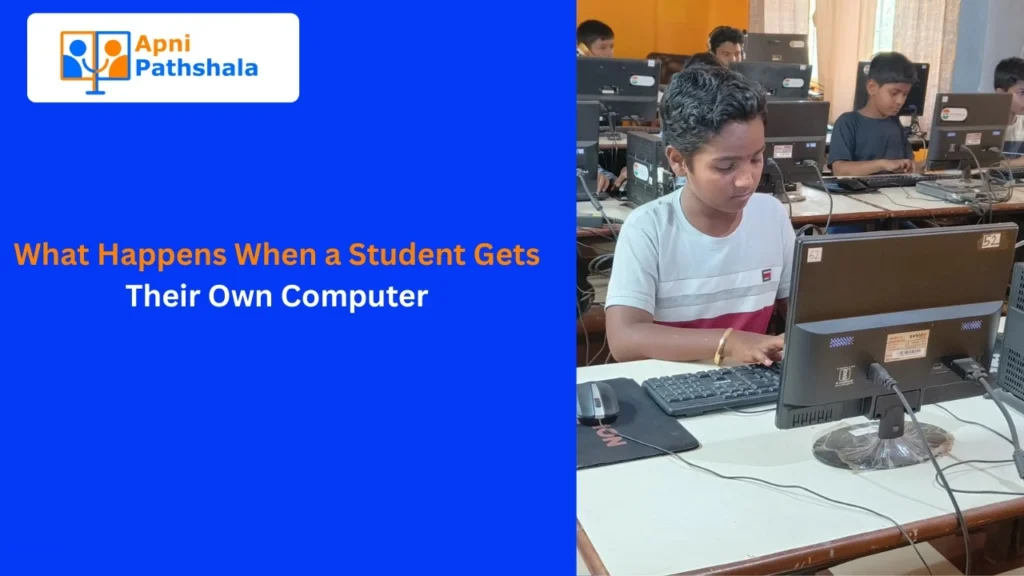
Devendra was born with 90% hearing impairment. For most of his life, the world communicated in a language he could only partially access. Schools weren’t designed for him. Instructions were spoken, not written. And the assumption, often unspoken but always present, was that he’d need someone else to translate everything.
Then he got his own computer. And something shifted.
Student computer access changes the equation entirely for students like Devendra. Not because the technology fixes a disability. But because it removes a hundred invisible barriers at once and gives a student control over how they learn.
What Student Computer Access Actually Unlocks
For a student with hearing impairment, a personal computer isn’t a convenience. It’s an equalizer. Video captions. Visual tutorials. Written instructions he could read at his own pace. The ability to pause, rewind, and replay without needing to ask anyone to repeat themselves.
Devendra learned Canva on his own. He watched tutorials, followed along step by step, and figured out design tools that most students his age hadn’t even heard of. Then he moved into video editing. Not because someone taught him in a classroom, but because he had student computer access that didn’t expire at the school bell.
That’s what personal access does. It gives students time. Uninterrupted, judgment-free time to explore something they’re interested in until they actually understand it.
The Transformation That Happens With Student Computer Access
Before Devendra had his own device, his learning was mediated by others. Everything went through someone else: a teacher, a peer, a family member who could hear the instruction he couldn’t. That dependency, while understandable, also limited him. He couldn’t learn faster than the person helping him. He couldn’t explore what he was curious about without coordinating with someone else.
Personal student computer access broke that dependency.
He wasn’t waiting for help anymore. He was learning when he wanted to learn, at the speed that worked for him, in the way that made sense to him. That shift from dependency to independence is one of the most significant things that can happen in a student’s life.
The real stories from students like Devendra are documented at Apni Pathshala’s student stories page. Each one shows the same pattern: access changes the trajectory.
Independence Isn’t Given. It’s Built Through Access.
There’s a tendency to treat students with disabilities as people who need more support, more accommodation, more specialized help. That’s true in some contexts. But Devendra’s story points to something different: sometimes what a student needs isn’t more help. It’s less friction.
Less friction between his curiosity and the tools that could satisfy it. Less mediation between his learning and his progress. Less dependence on a system that wasn’t designed with him in mind.
Student computer access gave him that. A device that didn’t judge, didn’t get tired, didn’t need him to explain his limitations before helping him learn. He could just… work. This is why education-focused computing environments matter so much. When the interface is clean and the tools are already there, the student’s energy goes into learning, not into fighting the technology.
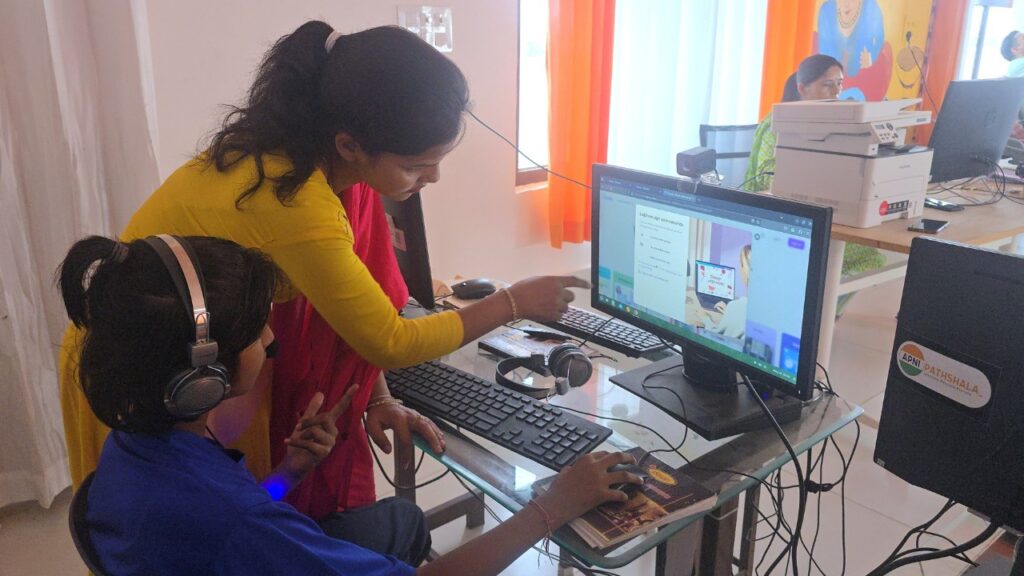
What Devendra Built, and What It Means
Devendra’s skills in Canva and video editing aren’t just hobbies. They’re marketable capabilities. Design, content creation, and video production are in demand. And he built those skills not because a teacher identified his potential and created a special program for him. He built them because he had consistent student computer access and the drive to use it.
That’s the version of this story that matters for every student, disabled or not. The computer doesn’t transform you. You transform yourself, using the computer as the tool. The access is what makes that possible.
Explore more about what changes when students get their own devices: Why Every Student Needs Their First Computer.
Student Computer Access Isn’t a Privilege. It’s a Starting Point.
Every student deserves their own space to learn. Not a shared lab, they get to use for an hour a week. Not a tablet that runs out of battery and can’t run real software. A proper personal computer that’s there when they want to learn, at 10 PM when inspiration hits, or at 6 AM before school starts.
Devendra found his capability through access. The student computer access he got didn’t just teach him design. It taught him that he could teach himself. That he didn’t need someone else to interpret the world for him.
That’s the transformation. And it starts with giving every student their own device. Read more on this: Digital Independence: When Students Take Control of Their Own Learning.