

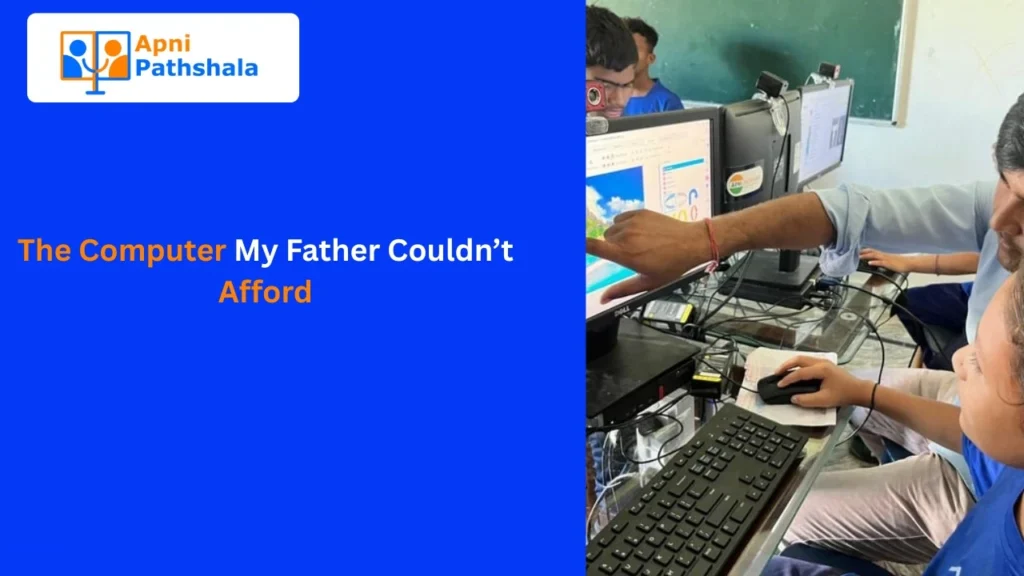
Surendra Kumar Saini grew up watching his father come home with chalk-dusted hands.
His father taught in a small government school in Rajasthan. Devoted man. Smart man. But when Surendra asked about computers (the ones he’d heard about from city kids), his father shook his head slowly.
“Not yet,” he said. “Maybe next year.”
Next year never came. Not until Apni Pathshala did.
I think about Surendra’s story a lot. Not because it’s unusual. Because it’s everywhere.
The Gap Nobody Talks About at the Dinner Table
There’s a version of India’s education debate that happens in English-medium drawing rooms, with parents who already have laptops and fast Wi-Fi. They argue about screen time, about distraction, about whether tablets are better than books.
That’s a real conversation. But it’s not the only one.
The other conversation, the one that doesn’t get as much airtime, is about families where the question isn’t what kind of computer to buy. It’s whether a computer will ever exist in the house at all.
Surendra was one of those kids. Economically weaker section, as the forms say. But here’s what the forms don’t say: he was sharp. Curious. The kind of student who finished his textbook before half the class had opened theirs.
Without digital access, that curiosity had nowhere to go.
What Happens When Access Finally Arrives
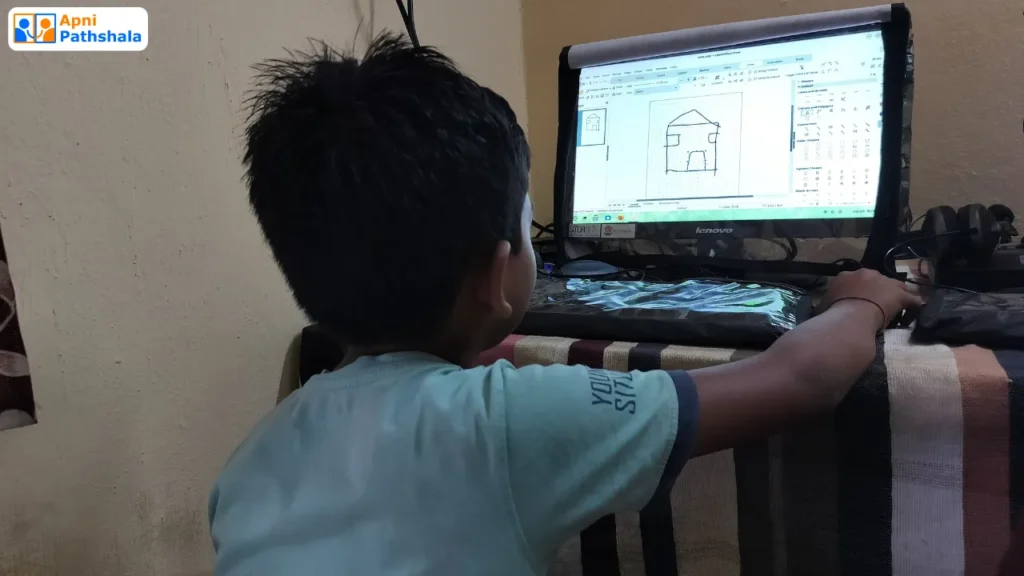
When Surendra got his first computer through Apni Pathshala’s program, he didn’t start slowly. He went all in.
Within months, he’d learned to operate software he’d only seen on distant screens before. He practiced typing. He explored. He made mistakes and fixed them. And eventually, he started his own e-Mitra shop, a digital services center that lets him help other people in his community access government services online.
That’s not just a success story. That’s a multiplier effect.
One computer. One student. Now an entire village gets digital help from someone who grew up in that same village, speaking that same language, understanding that same struggle.
You don’t get that from a laptop handed to a kid who already has three at home.
Why the First Computer Is Different From Every Computer After
Ask anyone who got their first computer late (in their teens, or later), and they’ll describe the experience in the same way. It doesn’t feel like getting a gadget. It feels like a door opening.
Not because computers are magical. But because access to information, to tools, to the ability to create something digital, that changes how a person sees their own potential.
Surendra didn’t just learn to use software. He learned that he could learn to use software. That gap, between “this is not for people like me” and “I can figure this out,” is the most important thing a first computer teaches.
It’s why digital skills build confidence in ways that textbooks alone never can. The doing is different from the reading about doing
The Real Cost of Not Having a Computer
We calculate the cost of buying a computer easily. We don’t calculate the cost of not having one.
Here’s what a student without digital access misses:
- The ability to research beyond what’s in their textbook
- Practice with tools that every employer now expects you to know
- The experience of failing safely: trying something, getting it wrong, trying again
- The confidence that comes from creating something: a document, a presentation, a video
By the time these students reach college or job interviews, they’re not behind academically. They’re behind experientially. And that’s harder to fix with a crash course.
Zorin OS, the operating system that powers Apna PC, was built with exactly this in mind. Zorin Education is designed to be clean, distraction-free, and approachable for students who are touching a computer for the first time. Not overwhelming. Not intimidating. Just usable.
Because the first experience matters enormously.
What Surendra’s Father Couldn’t Give, And What Changed
Surendra’s father wasn’t failing his son. He was doing everything a man with chalk-dusted hands and a government school salary could do.
The problem was never intent. It was access.
That’s what Apna PC was built to solve. A refurbished Mini PC with 8GB RAM, pre-installed educational tools, and a safe learning environment, at a price that doesn’t require a family to choose between a computer and groceries.
It’s not a luxury product dressed down. It’s a purpose-built machine for students who’ve never had the option before.
And when that machine lands on a desk in a house that’s never had one: something changes. Not just for the student sitting in front of it. For the next generation too.
Surendra’s kids, when he has them, will grow up with a computer in the house.
That’s how cycles break. Not dramatically. Quietly. One first computer at a time.
The Question Worth Asking
We spend a lot of energy debating the right kind of education. Curriculum, pedagogy, teacher training. All important.
But there’s a simpler question underneath all of it: Does this child have the tools to learn?
Because as every student deserves their first computer, and what happens after that first experience is often the difference between staying curious or giving up.
Surendra didn’t give up. He couldn’t afford to. And now, he runs a shop that makes sure others in his town don’t have to either.
His father couldn’t give him a computer. But the moment one arrived, he did everything with it.
That’s the whole point.
Want to change a student’s life? Give them their first computer. Buy Apna PC here and make it happen.