

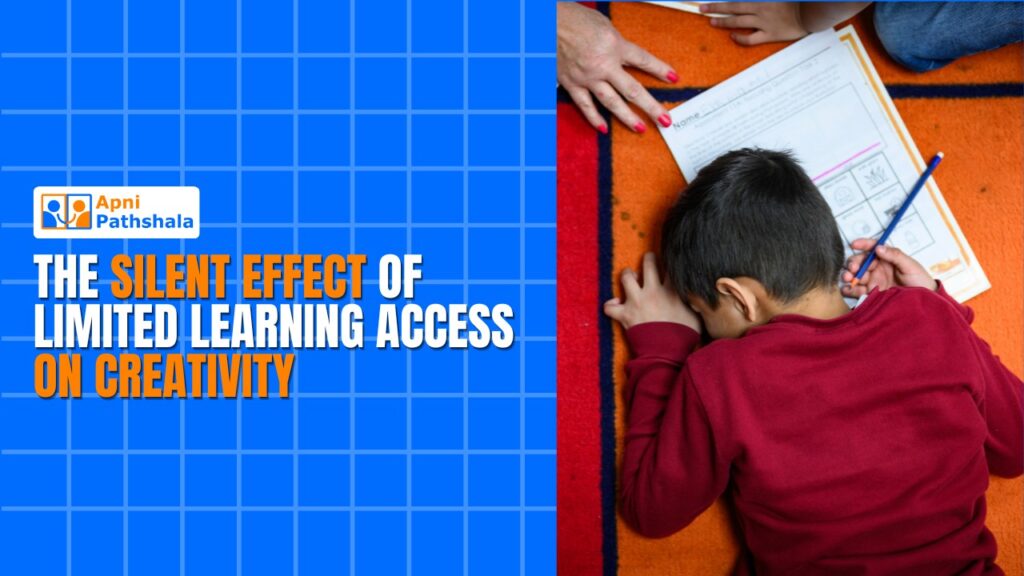
Most conversations about education in India focus on marks, attendance, and syllabus completion. Few people stop to ask whether a student’s creativity is growing alongside their grades. But creativity in students is not a bonus; it is the foundation of problem-solving, original thinking, and the kind of learning that actually sticks. When access to tools is limited and devices are shared or unavailable, creativity is often the first thing to quietly disappear without anyone realizing.
How Limited Access Quietly Shrinks a Student’s World
Creativity does not disappear overnight. It shrinks in small, unnoticed ways when a student cannot explore a topic beyond what the textbook offers, when curiosity stops at the end of a chapter because there is no device to follow up with, and when a child has an idea but no tool to develop it. The idea fades. The habit of following curiosity fades with it.
The impact of technology on creativity is often discussed in terms of the risks of excessive screen time and distractions. But for millions of Indian students, the more pressing reality is the opposite. They do not have too much access. They have far too little. And limited access means limited inputs, fewer ideas encountered, fewer possibilities imagined, and fewer creative problems ever attempted.
Creativity is built through exposure. A student who can only access what is inside a textbook works with a very narrow palette. One who can explore freely through videos, reading, digital tools, and independent experimentation builds a richer, more connected mental world. The range of inputs directly shapes the range of ideas a student can generate.
According to UNESCO global education research, learning environments that offer students diverse inputs consistently produce more creative and adaptive thinkers. Access is not separate from creativity. It is one of its core ingredients, and removing it quietly limits what a student believes is possible.
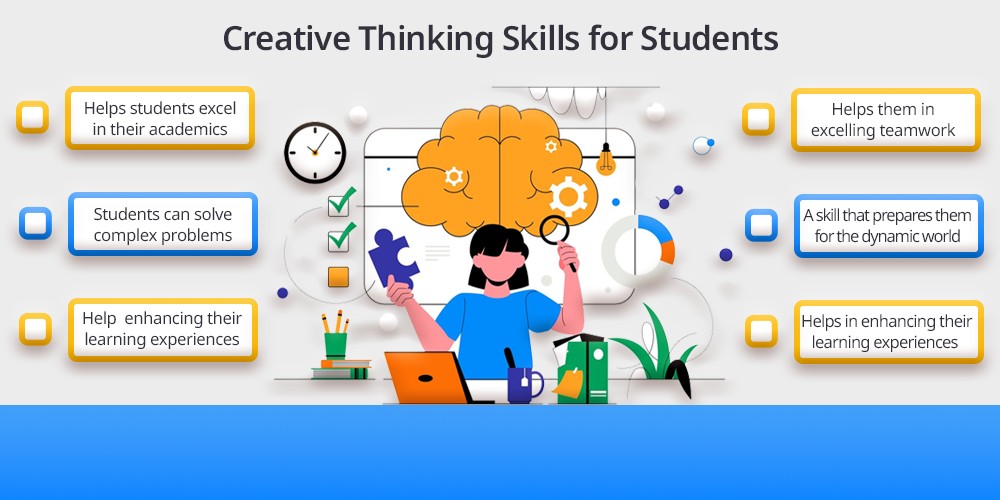
What a Digital Learning Environment Does for Creative Thinking
A digital learning environment does more than move content from paper to screen. When accessed consistently and without interruption, it changes how a student relates to knowledge, from a passive recipient to an active explorer.
A student with a personal computer can draw connections between subjects, follow up on ideas sparked by classroom discussions, take on open-ended projects with no single right answer, and revisit difficult concepts until they are genuinely understood. These are creative acts. They may not show up on a report card, but they build the mental flexibility that every future skill depends on.
The difference is not simply about having the internet. It is about having a reliable, uninterrupted space to think, make, and discover. A shared phone borrowed for twenty minutes cannot provide that. A personal device always available, always ready can.
The UNICEF India education report highlights that students in under-resourced environments consistently show lower rates of creative engagement, not due to a lack of creativity, but because their environments do not support it. The constraint is structural, not personal. And structural constraints can be addressed.
Building Student Creativity Development at Home
Student creativity development does not require a specialized classroom or expensive materials. It grows wherever the right conditions exist: curiosity, access, time, and the freedom to explore without a fixed answer expected at the end.
Families in Tier 2 and Tier 3 cities often assume creativity belongs in better-resourced schools, the ones with science labs, project-based learning, and art programs. But creativity grows wherever conditions allow. The single most important condition is consistent access to a tool that opens possibilities rather than limiting them.
Understanding The Hidden Cost of Not Having a Computer in 2026 goes beyond academic performance. Every year without a dedicated device is a year in which curiosity is quietly rationed, shaped not by what a student wants to explore, but by what a shared phone and a limited window of time will allow. That cost compounds invisibly.
The biggest advantage a student can have today isn’t marks, it is the ability to think originally, adapt to new problems, and learn independently without waiting for instruction. These traits do not grow through memorization alone. They grow through years of being in an environment that makes exploration possible.
Apna PC is an affordable, education-ready computer for Indian students, available at ₹21,000 (shipping and GST excluded). Designed for Tier 2 and Tier 3 cities, it gives students the consistent access they need for creativity to survive and grow. Visit apnapc.com to learn more.