

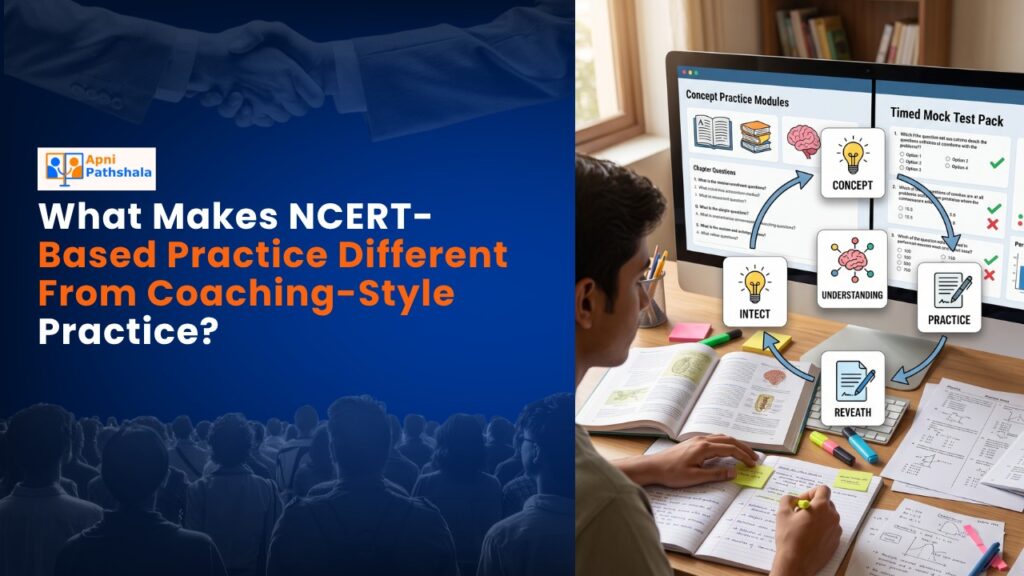
Rajesh’s Dilemma: Why His Son Scored 62% Despite Coaching
Rajesh sat in his Indore living room, staring at his son Arjun’s report card. Twelve thousand rupees spent monthly on coaching classes in a cramped tuition centre, yet Arjun scored 62% in his Class 10 Science exam. His neighbour’s daughter, who studied from NCERT books at home using structured NCERT practice, scored 89%. That evening, Rajesh realised something wasn’t adding up. The coaching centre promised shortcuts and tricks, but the board exams tested something different: deep understanding of NCERT concepts.
If you’re a parent in Tier 2 or 3 cities facing this same confusion, you’re not alone. Many families believe coaching classes are the only path to good scores. But NCERT-based practice offers something coaching-style practice often doesn’t: alignment with what your child actually needs to know.
What Is NCERT Practice and Why It Matters
NCERT practice means solving questions directly from NCERT textbooks and working with concepts exactly as they’re presented in your child’s curriculum. The National Council of Educational Research and Training creates these books for the Central Board of Secondary Education (CBSE) and most state boards.
When your child focuses on NCERT questions, they learn the exact way examiners expect answers. The language matches. The concepts align. The difficulty level reflects what will actually appear on exam day.
Coaching classes, by contrast, often use their own materials. They teach tricks to solve problems faster. They focus on pattern recognition rather than core understanding. Your child might solve a problem in 30 seconds using a coaching shortcut, but when the exam asks the same concept differently, they’re lost.
The Real Difference: Depth vs Speed
Coaching-style practice prioritises speed. Teachers show your child how to spot question patterns and apply formulas without fully understanding why those formulas work. Your child learns to recognise “this is a type A question, use formula X.” It works until the examiner slightly changes the format.
NCERT practice builds depth. Your child isn’t memorising patterns; they’re understanding principles. When they know why a concept works, they can apply it to any question, any format, any year.
Consider a Physics example. A coaching class might teach: “For this type of problem, always use v=u+at.” Your child memorises it, solves 50 similar problems, feels confident. Then the exam asks something slightly different, and they panic because they never understood what velocity, acceleration, and time actually represent.
With NCERT-based practice, your child learns the concept first. They understand that velocity changes due to acceleration over time. Now they can solve not just the textbook question, but variations they’ve never seen before.
NCERT Questions Are Exam Questions
Here’s a truth many coaching centres won’t tell you: board exams are built from NCERT concepts. Your child’s examiner studied the same NCERT curriculum.
When your child practices NCERT questions consistently, they’re essentially practising actual exam patterns. The language is familiar. The concepts are prioritised correctly. There are no distracting shortcut methods that confuse understanding.
This doesn’t mean NCERT-based practice alone is enough. Your child still needs good guidance, regular revision, and structured planning. But the foundation must be NCERT, not coaching materials.
Why Coaching Classes Miss the Mark
Coaching centres operate on volume. They teach large batches, focus on students who’ll score 90%+, and ignore individual learning gaps. Your child might not understand the concepts in Chapter 3, but the class has already moved on to Chapter 5 because they’re following their own syllabus rather than NCERT’s.
They also create dependency. Your child learns to think, “I can’t solve this without my coaching teacher’s trick.” This confidence disappears during exams when they’re alone.
Coaching classes also cost significantly more than self-study with proper resources. Twelve thousand rupees monthly adds up to one lakh forty thousand rupees yearly. That’s a substantial investment for many families in Tier-2 and Tier-3 cities.
Building Better Study Habits at Home
The good news: you don’t need expensive coaching to master NCERT-based practice. You need the right environment and tools. Your child needs a dedicated study space, access to NCERT materials, and a structured plan.
This is where technology helps. Devices like Apna PC come pre-loaded with educational software that helps organise your child’s practice routine. With 8GB of RAM and a 128GB SSD, your child can access digital NCERT books, practice question banks, and track their progress without distractions.
You can read more about developing study habits with Apna PC to understand how the right device supports NCERT-based learning.
NCERT Practice for Competitive Exams Too
NCERT isn’t just for board exams. Most competitive exams, including scholarship exams and olympiads, test NCERT concepts at advanced levels. If your child thoroughly masters NCERT, they’re already ahead in these competitions.
Coaching classes often jump straight to advanced problems, assuming students have a strong foundation in NCERT. Many don’t. This is why NCERT practice first, coaching later (if needed) is the smarter sequence.
Access to Quality NCERT Resources
The DIKSHA digital learning platform offers free NCERT textbooks and practice questions. The Central Board of Secondary Education (CBSE) website provides official question papers and curriculum guidelines.
Your child can access these resources from any device. A computer with good processing power makes this experience smoother, especially when handling multiple tabs, videos, and practice modules simultaneously.
The Investment That Actually Works
Instead of spending twelve thousand rupees monthly on coaching, consider investing in a quality educational device. Apna PC costs 30,000 rupees (excluding shipping and GST) and comes preloaded with Zorin OS, Apni Prerna for student monitoring, LibreOffice for document work, and Scratch for coding basics.
This one-time investment supports your child’s learning for years to come. Your child gets a distraction-free study environment, parental monitoring tools, and online access to all NCERT resources.
The real value isn’t in the device itself. It’s in what your child learns: self-discipline, independent problem-solving, and deep understanding of concepts. These skills serve them far beyond exams.
Making the Switch: A Parent’s Checklist
If you’re considering moving from coaching-style practice to NCERT-based practice, here’s what to do. First, download NCERT textbooks for your child’s class and subjects. Read each chapter carefully together and discuss important points.
Next, solve every NCERT question given at the end of each chapter. Write solutions in a separate notebook rather than just thinking through the answers. This forces deeper engagement with the problem. Check answers against NCERT solutions only after attempting every question.
Create a separate notebook for questions your child got wrong. Review these mistakes weekly so they don’t repeat during the exam—track which topics cause the most trouble and spend extra time on those areas.
Finally, solve NCERT practice questions under timed conditions during the final month of preparation. This trains your child’s brain to work under exam pressure while maintaining accuracy.
Visit apnapc.com to learn more about giving your child the right tools for NCERT-based exam preparation.