

The Moment Everything Changed
Riya was nine years old when her father brought home a second hand computer from a shop in Nagpur. It wasn’t fancy. The screen had a scratch on one corner, and the keyboard made a clicking sound every time you pressed the spacebar. But Riya didn’t care.
She sat in front of it for three hours straight. Didn’t eat her snack. Didn’t watch TV. Just clicked around, opened folders, typed her name over and over again in Notepad.
Her mother thought it was a phase. It wasn’t.
Within six months, Riya was making her own school presentations. By the end of the year, she was teaching her younger cousin how to use Google. Today, she’s preparing for her Class 10 boards with online resources she found herself.
That’s what happens when a child gets their first computer. It doesn’t just sit on a desk. It opens a door.
It’s Not About the Machine, It’s About What They Discover
Most parents think buying a computer means their child will “learn computers.” That’s only half the story. What actually happens is much bigger than that.
Kids don’t just learn how to use software. They start exploring. A child in Lucknow might stumble onto Khan Academy and suddenly understand fractions better than they ever did in class. A student in Coimbatore might discover Scratch programming and build a small game before dinner.
The first computer doesn’t teach one thing. It teaches curiosity.
And that’s something no textbook can do. According to UNICEF’s education research, access to digital tools in early childhood is directly connected to better learning outcomes later in life.
The Quiet Confidence That Builds Over Time
Here’s something parents don’t always notice right away. A child with their own computer starts carrying themselves differently. They’re not borrowing a phone to look something up. They’re not waiting for computer class at school to practice typing.
They have their own space. Their own machine. And with that comes a sense of ownership that changes how they approach learning altogether.
We’ve seen this pattern again and again with Apna PC users across India. Kids who were shy about technology start volunteering to help other students. Kids who struggled with English start watching YouTube tutorials and picking up the language naturally.
It’s not magic. It’s access.
Real Stories From Real Families
A father in Jaipur told us his daughter used her Apna PC to learn typing so fast that she now types his office emails for him on weekends. He laughed about it, but you could tell he was proud.
A mother in Patna said her son stopped asking for her phone after he got his computer. Instead, he started spending time on educational apps and even figured out how to download his school’s online worksheets on his own.
These aren’t exceptional kids. They’re ordinary children who got one extraordinary thing: their own computer.
NCERT has been pushing for digital integration in classrooms for years now. But the truth is, the real transformation happens at home, where a child can explore without a bell ringing every 40 minutes.
What Parents Should Know Before That First Setup
If you’re thinking about getting your child their first computer, here are a few things that actually matter:
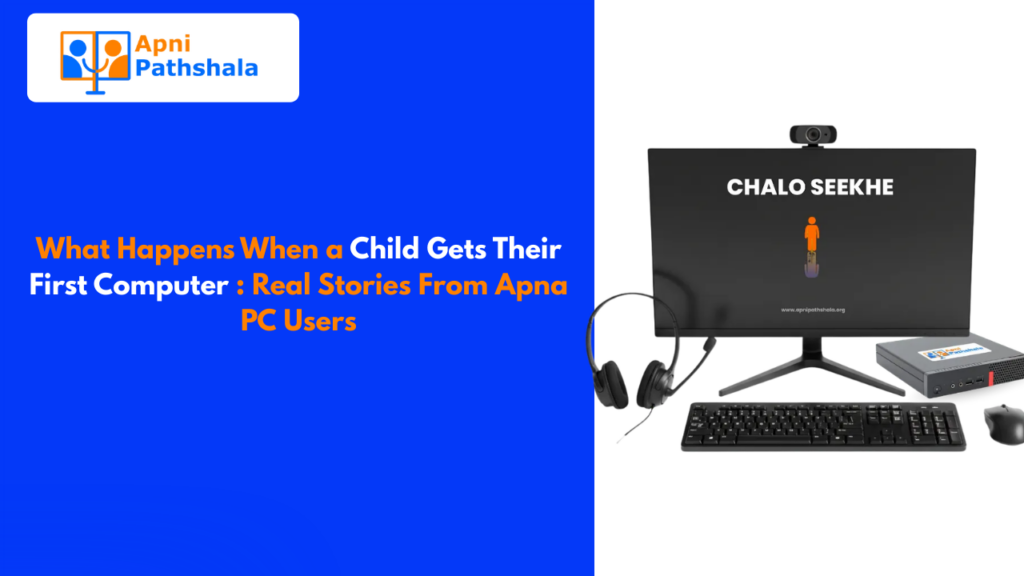
Don’t obsess over specs. A child doesn’t need the latest processor. They need something reliable that turns on quickly and runs basic learning tools without freezing. That’s exactly what refurbished computers with Apna PC’s educational setup are designed to do.
Set it up together. Let your child watch you install things. Let them choose their wallpaper. Let them name the computer if they want. This sounds silly, but it builds attachment and responsibility.
Don’t hover. The biggest mistake parents make is standing behind their child watching every click. Give them room. You can always check later what they’ve been doing.
The Ripple Effect Nobody Talks About
When one child in a family gets a computer, something interesting happens. Younger siblings start watching. Cousins come over to try it. Neighbors ask where you bought it.
One computer doesn’t just change one child. It changes a household.
We’ve heard stories from families in tier 2 and tier 3 cities where a single Apna PC became the study hub for three or four kids in the same building. They’d take turns, help each other, and end up learning things none of them would have discovered alone.
That’s the ripple effect. And it starts the moment a child sits down in front of their first screen and thinks, “This is mine.”
A computer in a child’s hands isn’t just a gadget. It’s a statement. It says, “We believe in your future.” And for kids in smaller towns who don’t always hear that message from the world around them, it means everything.
If you haven’t given your child that moment yet, maybe it’s time. You don’t need to spend a fortune. You don’t need the fanciest brand. You just need something that works, something that’s theirs, and the willingness to let them explore.
Because the moment a child realizes they can learn anything on their own? That’s the moment everything changes.