

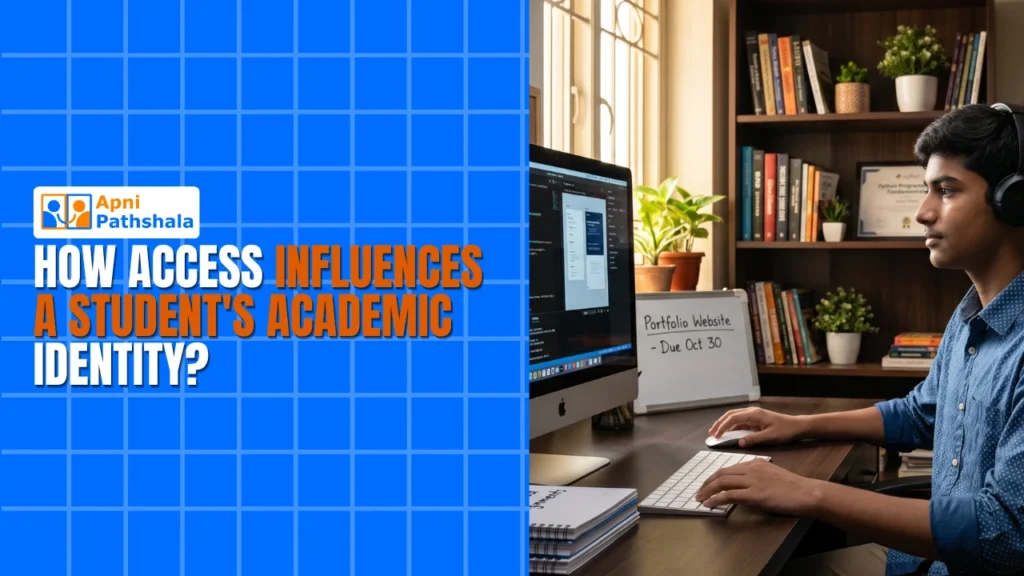
Ask a Class 10 student who they are, and they will tell you their marks. “I am an 85 percent student.” “I am a topper.” “I am average.” Their entire academic identity is built around a number on a report card. But marks do not tell the whole story. They do not show curiosity. They do not show creativity. They do not show how a student thinks when nobody is grading them.
There is another way students build their academic identity. Through the tools they use, the projects they create, and the problems they solve on their own. A student who builds a game in Scratch sees themselves differently than a student who only memorizes textbook answers. One knows they can create. The other only knows they can memorize.
Student academic identity is not formed in the exam hall. It is formed in the hours between school and sleep. And the tools available during those hours shape everything.
What Shapes a Student’s Academic Identity
A student’s academic identity is the answer to a simple question: “What kind of student am I?” Most students answer this based on their marks. But marks are a narrow measure. They test memory, not ability. They test compliance, not curiosity. They test how well a student follows instructions, not how well they think independently.
The students who build a richer academic identity are the ones who have access to tools that let them explore beyond the textbook. A student who uses a computer to research topics they are curious about starts seeing themselves as a learner, not just a test-taker. A student who builds projects on their own starts seeing themselves as a creator, not just a consumer of information.
Access to education is not just about having a good school. It is about having the right tools at home. A child with a computer has access to the entire world of knowledge. A child without one has access only to what the textbook and the teacher choose to share.
How a Computer Changes Self-Perception
When a child uses a computer to build something, even something small, their self-perception shifts. They stop thinking of themselves as just a student who studies for exams. They start thinking of themselves as someone who can make things, solve problems, and create value.
This shift matters more than most parents realize. A child who sees themselves as a creator approaches problems differently. They do not wait for someone to give them the answer. They try to figure it out. They remain calm when they do not know something. They search for it. They do not feel helpless in front of a new challenge. They feel capable.
Student confidence is directly tied to this self-perception. A student who has built three projects in Scratch believes they can build a fourth. A student who has only memorized textbook answers has no such belief. One is confident because they have evidence of their ability. The other is uncertain because they have never tested it.
A personal computer helps students learn beyond the school curriculum. But more importantly, it helps a student see themselves as more than a number on a report card.
Why Learning Motivation Follows Identity
Learning motivation is not something you can force. You cannot make a child curious by simply telling them to be curious. You cannot make them engaged by threatening them with consequences. Motivation comes from identity. A child who sees themselves as a learner is naturally motivated to learn.
When a student builds something on a computer and feels proud of it, they want to build more. When they solve a problem independently and feel the rush of success, they want to solve even more problems. The motivation is internal. It does not come from marks, rewards, or parental pressure. It comes from the satisfaction of creating something on their own.
This is why access matters so much. A child without a computer never gets to experience this satisfaction. Their only source of academic feedback is marks. And marks are a poor motivator because they are external. A child studies to get marks, not because they enjoy learning. The moment the exam is over, the motivation disappears.
The biggest advantage a student can have today is not marks. It is an academic identity built on creation, not memorization. A computer provides every child that opportunity.
What Parents Can Do
You cannot change how the school system measures your child. You cannot replace exams with projects. But you can change what happens at home. You can provide your child a tool that lets them build an identity beyond marks.
Give them a computer. Let them explore. Let them build things. Let them fail and try again. Do not measure their progress by grades. Measure it by what they created today that they could not create yesterday.
Within weeks, you will see the change. Your child will start talking about what they built, not just what they scored. They will start showing you projects, not just report cards. They will start seeing themselves as someone who can do things, not just someone who can pass exams.
That shift in student academic identity is worth more than any mark on any report card. It is the foundation of a person who believes in their own ability. And it starts with access to a computer.
Apna PC comes pre-loaded with Scratch, LibreOffice, VS Code, Blender, and Arduino IDE. At ₹21,000 (shipping and GST excluded), it gives your child the tools to build an academic identity based on creation, not just memorization. Visit apnapc.com to learn more.