

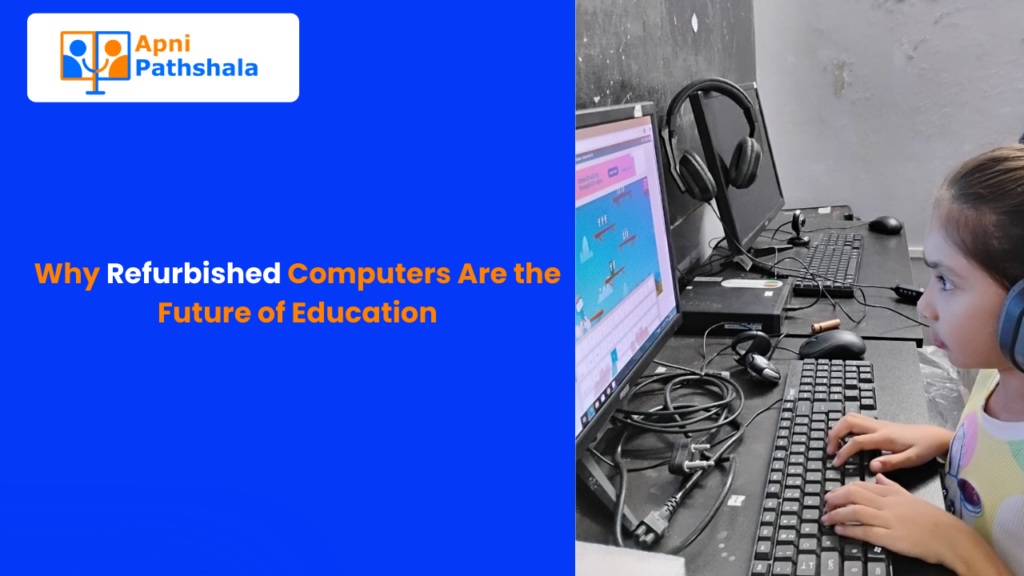
There is a quiet revolution happening in classrooms and homes across India, and it does not look like the sleek product launches you see in tech news. It looks like a well-restored laptop sitting on a student’s desk in a government school. It looks like a child in a small town opening a browser for the first time. Refurbished computers are not a compromise. They are becoming one of the smartest tools in the fight to make education genuinely accessible.
The Economics Make Undeniable Sense
Let us start with the numbers because they tell the story clearly. A brand new mid-range laptop in India costs anywhere from twenty-five thousand to forty thousand rupees. A quality refurbished machine from a reliable source like Apna PC can cost a fraction of that while offering comparable performance for everyday educational use.
For schools operating on tight budgets, that difference is transformative. Instead of equipping one computer lab with twenty new machines, the same budget can furnish two or three labs with refurbished ones. More students get access. More hours of learning happen. The return on investment is simply better.
For families, it means that a computer, which was previously an unthinkable purchase, suddenly becomes reachable. That shift in accessibility is enormous. Digital literacy cannot happen without devices, and devices cannot reach everyone if the price point never comes down.
Refurbished Does Not Mean Inferior
There is a persistent misconception that refurbished means broken-once, barely-working, or somehow second-rate. That is not how it works when the process is done properly. A responsibly refurbished computer goes through cleaning, hardware checks, component replacement where needed, software installation, and quality testing before it reaches anyone.
What you get is a machine that performs reliably for the tasks students actually need it for: word processing, internet research, watching educational content, practising coding, creating presentations, and managing files. The vast majority of school and home learning tasks do not require cutting-edge processors or premium displays.
Apna PC takes this responsibility seriously. Every device is tested and prepared to meet a standard that makes it genuinely useful, not just technically operational. That distinction matters. Read more about how Apna PC empowers students through digital access and what that commitment looks like on the ground.
The Environmental Case Is Just as Strong
Education is not the only reason to take refurbished computers seriously. The environmental argument is compelling on its own.
Electronic waste is one of the fastest-growing waste streams in the world. When a functional computer is discarded simply because a newer model exists, it generates hazardous materials and squanders the energy and resources that went into making it. Extending the useful life of a device through refurbishment is one of the most concrete things a supply chain can do to reduce its environmental footprint. According to UNEP’s Global E-Waste Monitor, the world generated 53.6 million metric tonnes of e-waste in 2019, with only 17% being formally recycled — making refurbishment a critical part of sustainable technology use.
Students who use refurbished machines are not just benefiting themselves. They are participating in a more sustainable model of technology consumption. For a generation that will have to live with the consequences of today’s environmental decisions, that is a meaningful lesson in itself.
Preparing Students for a Digital World
The argument sometimes comes up that students should have access to the latest technology to be properly prepared for the modern workforce. There is a grain of truth there, but the framing misses something important. The most critical step is not having the newest device. It is having any device at all.
A student who has spent years becoming comfortable with computers, learning to type quickly, navigating software, solving problems when something does not work, and building confidence in digital spaces, is dramatically better prepared than a student who has never touched a computer but theoretically has access to a new one occasionally.
Consistent access beats occasional premium access every time. Refurbished computers in homes and classrooms create the daily familiarity with technology that truly prepares students for what comes next. Whether a student wants to study engineering, business, design, or anything else, that foundation of digital comfort is essential. As highlighted in our piece on why digital skills are becoming as important as reading and writing, early and consistent access to technology is what makes the difference.
Conclusion
The future of education in India will not be built on the assumption that every student can afford a new device. It will be built on systems that are smart about resources, equitable in distribution, and serious about outcomes. Refurbished computers sit right at the intersection of all three. The ITU’s digital inclusion data consistently shows that device access remains one of the single biggest barriers to education participation in developing nations — and refurbishment is one of the fastest paths to closing that gap.
Apna PC is not just selling old machines. It is expanding the boundaries of who gets to participate in digital education. That is a future worth investing in.