

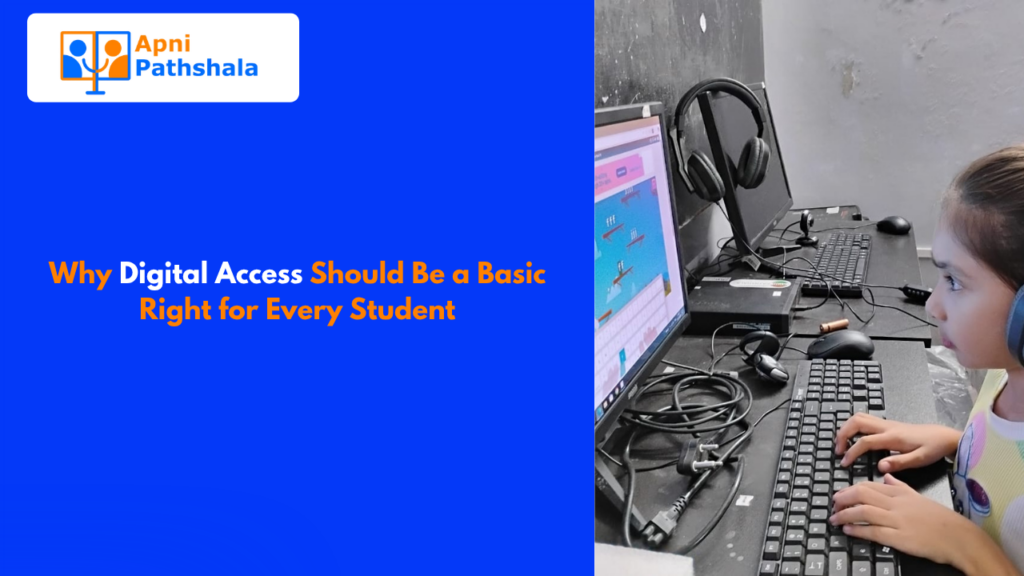
Sruthi’s father comes home every evening with cement dust on his hands. He’s a construction worker. And for years, Sruthi, a Class 9 student, would watch her classmates talk about online resources, YouTube tutorials, and digital projects she couldn’t even picture. Not because she wasn’t smart. But because she’d never touched a computer.
That changed when Sruthi got her first device through Apni Pathshala. And the first thing she said? “I didn’t know this is what learning could feel like.”
That sentence should shake something in us. Because if one child can feel that way, how many more are out there still waiting?
What We Mean When We Say “Basic Right”
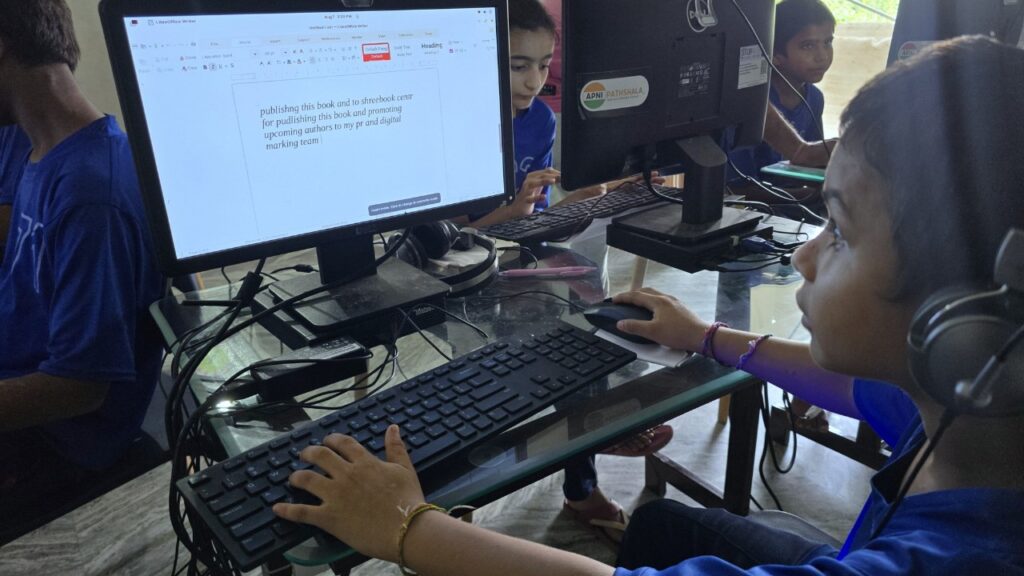
We talk about the right to education. It’s in our Constitution. It’s in international frameworks. But digital access, the actual ability to use a computer, connect to the internet, and learn through technology, that’s treated like a luxury. Something nice to have. A bonus, not a baseline.
That framing is outdated.
Today’s education doesn’t just happen in classrooms. It happens on Khan Academy. On NCERT’s digital portal. On YouTube channels run by teachers who explain concepts better than any textbook. If a student can’t access these things, they’re not just missing extras. They’re missing a core part of how learning works now.
The Gap Is Real, and It’s Growing
Here’s what the data actually shows: India has over 250 million school-age children. A massive portion of them especially in rural areas don’t have a computer at home. They share a phone with four family members. They download notes in the morning when data is cheaper and try to study from a 5-inch screen.
Meanwhile, students in cities have:
- Personal laptops or desktops
- Reliable broadband
- Access to paid platforms and apps
- Parents who can guide them through technology
This isn’t just an economic gap. It’s a learning gap that compounds every year. The longer a student goes without a proper computer, the further behind they fall, not just in skills, but in confidence.
Why Phones Aren’t Enough
A lot of people say, “But kids have smartphones now.” True. But a phone is not a computer. You can’t type a 1,000-word essay on a phone without wanting to quit. You can’t code on a phone. You can’t run spreadsheets, create presentations, or do design work on a 6-inch screen with a virtual keyboard.
Phones give you information. Computers help you create.
And real education is about creation. Writing, building, experimenting, making. Students who only consume content on phones are always one step behind students who create on computers.
Devendra Proved What’s Possible
Devendra has a 90% hearing impairment. The education system had quietly written him off in certain ways — he couldn’t participate in discussions, couldn’t hear lectures, couldn’t follow along the way other students could.
When he got access to a computer, that changed. He taught himself Canva. Then video editing. He started creating content that told his own story, in his own way, through visuals and design. His hearing impairment didn’t disappear. But his access to tools meant he could express himself fully, something the traditional classroom had denied him.
That’s what happens when you treat digital access as a right rather than a reward.
The Economic Argument Alone Isn’t Enough
People argue that giving computers to students is a good economic investment. Digital skills increase earning potential. That it’s good for GDP. All of that is true.
But we shouldn’t need an economic justification to give children what they need to learn. The argument for digital access shouldn’t just be “it’ll make them more productive workers.” It should be “they deserve to learn. Fully. Without being held back by what they were born into.”
Education is a right. And right now, education without digital access is an incomplete right.
What Schools and Parents Can Do Right Now
You don’t have to wait for government policy to change. There are practical steps that move the needle:
- Advocates at the school level push for computer labs with actual functional machines, not display-only setups
- Look for affordable, purpose-built devices. Not every student needs a ₹60,000 laptop; there are options designed for learning
- Treat screen time differently. Scheduled, purposeful computer time is different from random scrolling
- Connect students to free platforms, Khan Academy, DIKSHA, NPTEL, and others, which are free; they just need a device to access them
The Conversation Has to Change
We need to stop talking about digital access like it’s a charity. Sruthi didn’t need charity. She needed what her classmates already had. Devendra didn’t need special treatment. He needed tools.
When we frame digital access as a right the same way we frame access to books, teachers, and classrooms, we start making decisions differently. We stop asking “can we afford this?” and start asking “how do we make this happen?”
Because the real question isn’t whether every student deserves a computer. It’s why we’re still debating it.
Ready to be part of the solution? Visit Apna PC to learn how education-focused computers are reaching students who need them most.