

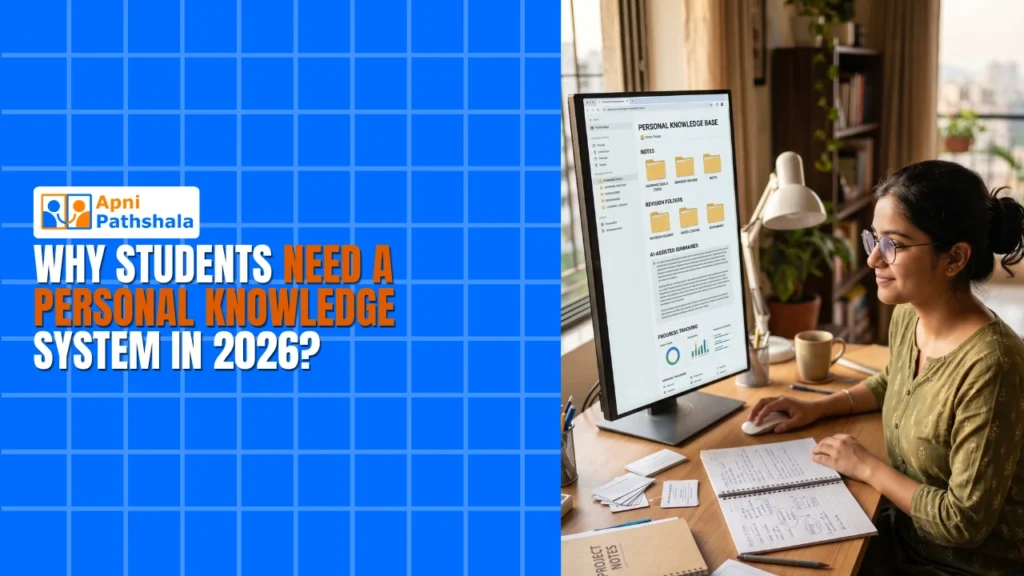
Shreya has ten notebooks. One for each subject. She writes notes in class, highlights key points, and revises before exams. Last month, she needed a formula she had written in her math notebook from Class 8. She spent two hours searching through old notebooks. She never found it. The notes were there. The system was not.
Her brother, two years older, uses a computer for his notes. He types them in a document, organizes them by subject in folders, and searches for any keyword in seconds. When he needs a formula from Class 8, he types the formula name and finds it in ten seconds. Same knowledge. Different system. Completely different outcome.
Personal knowledge management is not about studying harder. It is about organizing what you learn so you can find it when you need it. In 2026, when students are drowning in information from textbooks, online courses, videos, and social media, the ability to organize knowledge is more important than the ability to acquire it.
Why Traditional Note-Taking Fails
Traditional note-taking has three problems that no amount of effort can fix.
First, it is not searchable. A student who writes notes in a notebook cannot search for a specific term. They have to flip through pages, hoping to find what they need. As the volume of notes grows, the time required to find anything grows with it.
Second, it is not organized dynamically. A notebook is organized by the order in which notes were written. A student who wants to see all their notes on a specific topic has to go through multiple notebooks. There is no way to reorganize notes by topic, by difficulty, or by relevance.
Third, it is not backed up. A notebook can be lost, damaged, or destroyed. Years of notes can disappear in a water spill or a house move. There is no copy. No backup. No recovery.
Digital note-taking solves all three problems. Notes on a computer are searchable. They can be reorganized instantly. They are backed up automatically. The knowledge is preserved. The system is efficient.
UNESCO global education research has documented how digital tools improve knowledge retention and recall in students. The tools are not magic. They are just better systems for organizing what the student already knows.
What a Personal Knowledge System Looks like?
A personal knowledge system is not just a folder of notes. It is a structured way of capturing, organizing, and retrieving information. It has three components: capture, organize, and retrieve.
Capture means writing down what you learn in a format that is easy to search. On a computer, the process means typing notes in a document with clear headings, bullet points, and keywords. A student who types notes can include links, images, and code snippets. The notes are richer than handwritten ones.
“Organize” means structuring the notes so they are easy to find. On a computer, this means creating folders by subject, subfolders by topic, and naming files clearly. A student who organizes notes digitally can reorganize them as their understanding grows. They can move a note from “Class 8 Maths” to “Algebra Fundamentals” without rewriting anything.
“Retrieve” means finding a specific piece of information quickly. On a computer, this action means using the search function. A student who needs a formula types the formula name and finds it in seconds. No flipping pages. No searching through old notebooks. Just a keyword and a result.
Student productivity tools like LibreOffice, text editors, and file managers make this system possible. The student does not need special software. They need a computer with basic tools installed.
How a Personal Computer Helps Students Learn Beyond the School Curriculum. But more importantly, it helps them build a system that makes every other learning tool more effective.
Why 2026 Make This Urgent?
The amount of information a student encounters today is ten times what it was a decade ago. Online courses, educational videos, social media posts, digital textbooks, and interactive platforms generate more content than any student can absorb. The students who thrive are not the ones who consume the most. They are the ones who organize the best.
A student without a personal knowledge system is drowning. They consume information but cannot retain it. They learn something valuable but cannot find it later. They study for hours but forget most of it within a week. The information enters their brain and exits without leaving a trace.
A student with a personal knowledge system is surfing. They capture what they learn. They organize it by topic. They retrieve it when they need it. The information enters their system and stays there. Over months and years, the system becomes a personal library that the student can search at any time.
Knowledge management for students is not a luxury. It is a survival skill. The students who manage their knowledge well will outperform those who consume more but organize less. The system is more valuable than the content.
The Hidden Cost of Not Having a Computer in 2026. But the cost of disorganized knowledge is higher. A student who cannot find what they learned is a student who has to learn it again.
What Parents Should Do?
Give your child a computer. Let them start building a personal knowledge system. Let them type their notes, organize them in folders, and search for them when they need to. The habit of organizing knowledge digitally will serve them for the rest of their lives.
Apna PC, priced at ₹21,000 (shipping and GST excluded), comes pre-loaded with LibreOffice and other tools that make personal knowledge management possible. Your child plugs it in and starts building their digital library from day one.
DIKSHA, India’s national digital learning platform offers digital resources for students across India. But without a system, resources are just noise. Give your child the system to turn information into knowledge. Visit apnapc.com to learn more.