

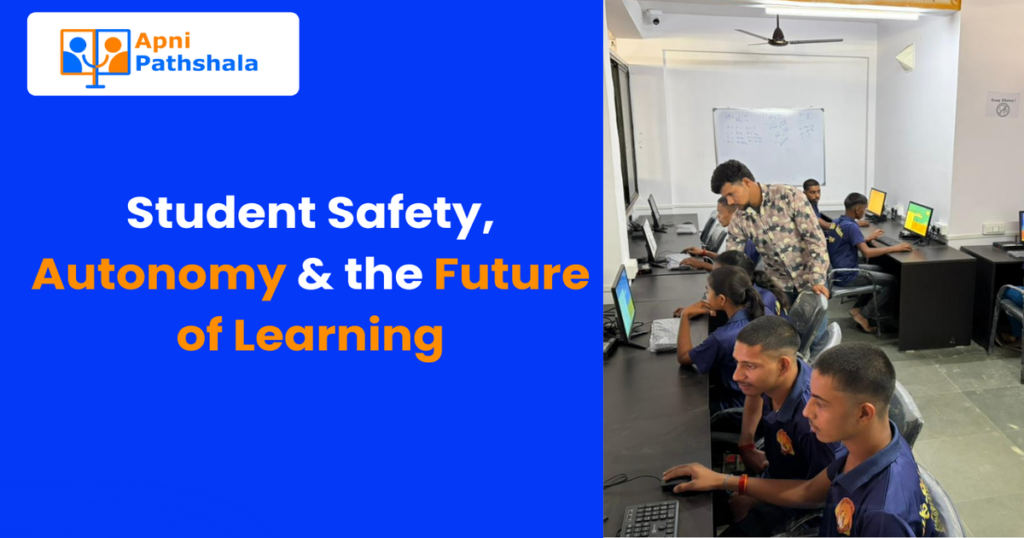
How Apna PC Is Redefining Safe, Self-Directed Education
In healthcare, one principle is universally accepted: informed and empowered patients achieve better outcomes.
The same principle applies to education.
At Apna PC, the student safety solution built into every device is not designed to control children. Instead, it is built to enable clarity, confidence, and conscious choice for students, parents, teachers, and policymakers alike.
This blog answers the most common questions about how the Apna PC Student Safety Solution works and why it represents a fundamental shift in how we think about learning in the digital age. Student Safety, Autonomy .
What Is the Student Safety Solution on Apna PC?
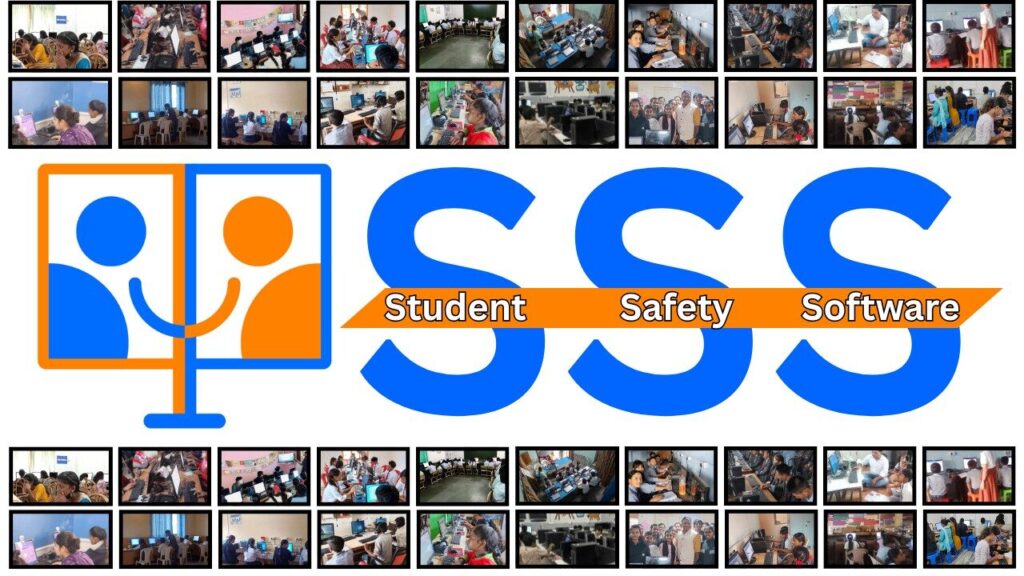
The Student Safety Solution is a smart, invisible learning layer that runs quietly in the background while a child uses their Apna PC.
Unlike traditional parental-control software that relies on aggressive blocking, this system works holistically. It simultaneously:
-
- Keeps students safe online
-
- Tracks real learning, not just screen time
-
- Builds a live digital learning dashboard
-
- Powers a personalised AI tutor
-
- Creates a verifiable learning record for the future
Think of it as guardrails, not handcuffs supporting progress without restricting curiosity. Student Safety, Autonomy.
How Does It Keep Students Safe Online?
The internet is an extraordinary learning resource, but it is not a babysitter.
The Apna PC safety system is designed to reduce exposure to digital distractions and risks by:
-
- Blocking pornographic and unsafe websites
-
- Limiting access to addictive games and mindless scrolling
-
- Discouraging excessive chatting during study hours
-
- Reducing “doom scrolling” that erodes attention and focus
Parents do not want surveillance tools.
They want peace of mind and this system delivers it quietly and reliably.
Is Apna PC Spying on Children?
No and this distinction is critical.
Spying destroys trust, and without trust, learning collapses.
The Apna PC system:
-
- Does not record keystrokes
-
- Does not monitor private messages
-
- Does not collect personal conversations
Instead, it observes learning patterns, not personal behaviour.
The central question it helps answer is simple yet powerful:
“Are you truly learning or just appearing busy?”
This reflection is essential for long-term academic and personal growth.
What Is the Digital Learning Dashboard?
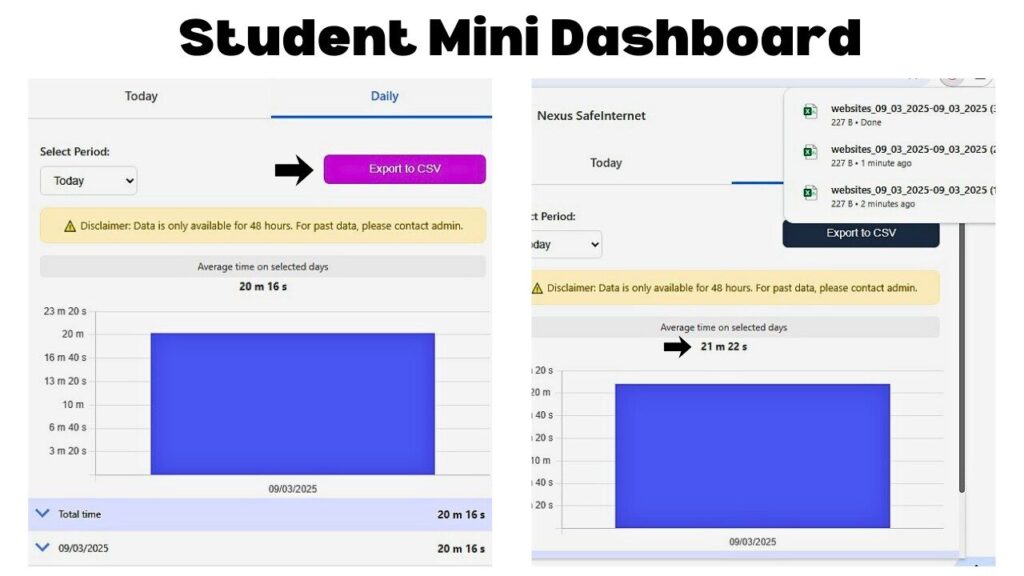
The Digital Learning Dashboard transforms invisible effort into visible insight.
It shows:
-
- Which subjects is the student exploring
-
- Which tools, platforms, and resources they use
-
- How interests evolve over time
-
- Whether learning is surface-level or deep
For the first time, parents and teachers can see what a child is actually learning, not just what the timetable claims.
Grades often measure compliance.
Dashboards reveal curiosity and direction.
How Does This Help Parents and Teachers?
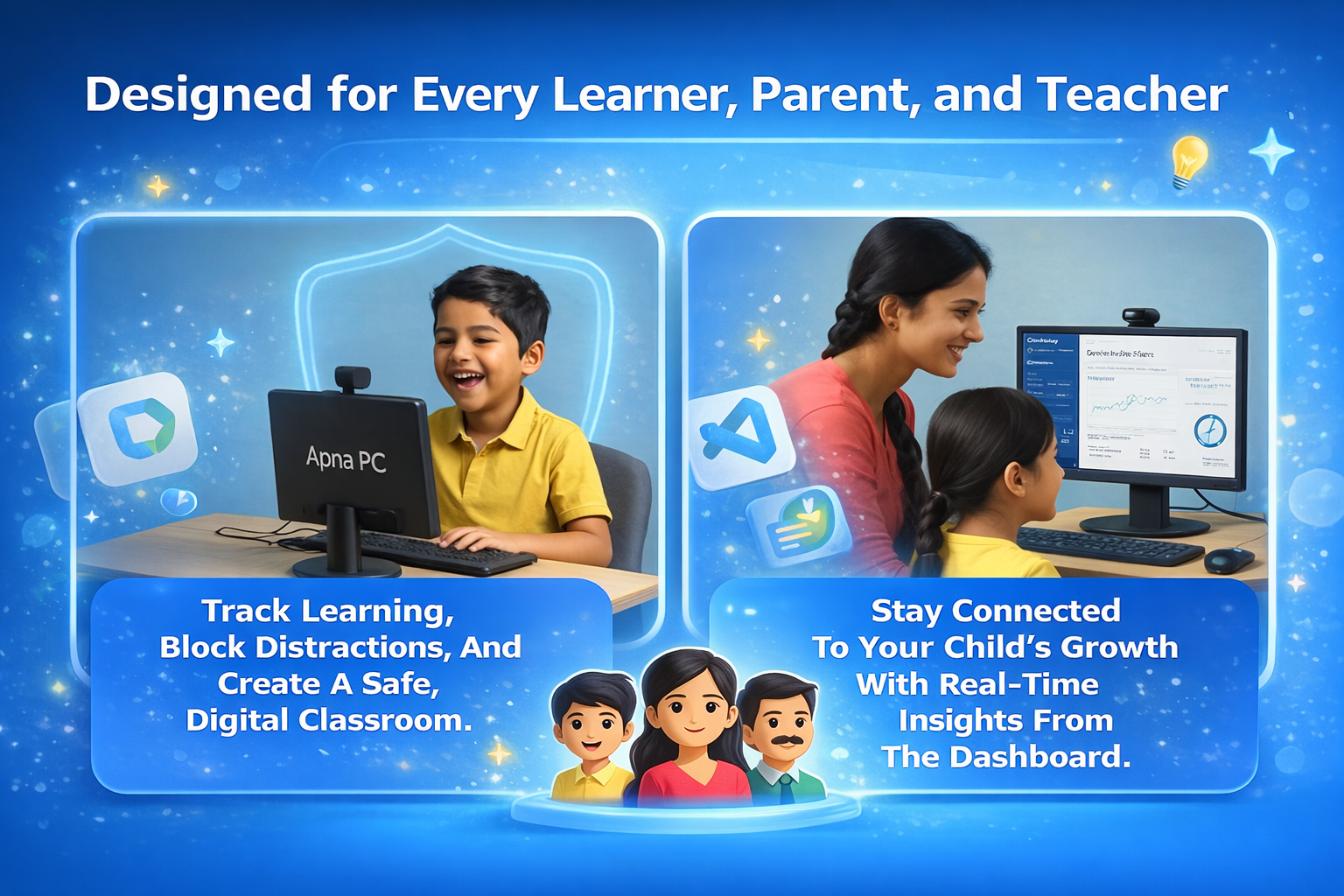
The system replaces guesswork with evidence.
Parents no longer need to ask:
-
- “Were you studying?”
-
- “Why are your marks falling?”
-
- “What are you really interested in?”
Teachers can:
-
- Support individual learning journeys
-
- Detect disengagement early
-
- Encourage strengths instead of enforcing uniform paths
This marks a shift from control-based supervision to coaching-based guidance a far healthier model for modern education.
How Does the AI Tutor Use This Data?
True personalisation is impossible without context.
The AI tutor on Apna PC:
-
- Understands what the student already knows
-
- Adapts to their pace and interests
-
- Avoids unnecessary repetition
-
- Provides focused support where the student struggles
In essence, the AI stops teaching subjects and starts teaching students.
This is how self-directed learning succeedsthrough feedback loops, not one-way lectures. Student Safety, Autonomy .
What Is the Student’s Personal Learning Website?
Every Apna PC student automatically builds a living digital portfolio.
Instead of saying “I studied this”, students can show:
-
- Projects they created
-
- Topics they explored
-
- Skills they developed
-
- Learning paths they followed
This personal learning website belongs to the student, not the institution.
In a future where skills outweigh degrees and proof matters more than promises, this portfolio becomes an academic passport. Student Safety, Autonomy .
How Does This Support Policymakers and Governments?
When anonymised and aggregated, learning data answers a question education systems rarely ask effectively:
“What do students actually want to learn?”
The data reveals:
-
- Emerging student interests
-
- Skills learners pursue independently
-
- Gaps between curriculum and reality
-
- Signals of future workforce needs
Instead of updating syllabi once a decade, policymakers can respond in real time.
Curriculum should follow learners, not the other way around.
Does This Reduce Student Autonomy?
Quite the opposite.
Autonomy does not mean absence of structure it means ownership with accountability.
The Apna PC system:
-
- Encourages self-awareness
-
- Builds intrinsic motivation
-
- Replaces fear with feedback
-
- Treats students as responsible individuals
Freedom without feedback leads to chaos.
Feedback without freedom leads to oppression.
This system balances both. Student Safety, Autonomy.
What Kind of Learners Does Apna PC Aim to Create?
The goal is not exam toppers.
The goal is to nurture:
-
- Independent thinkers
-
- Curious explorers
-
- Lifelong learners
-
- Self-directed problem solvers
Students who stop asking:
“Will this be in the exam?”
And start asking:
“Why does this matter?”
That is where real education begins. Student Safety, Autonomy .
Final Thought
For decades, education systems have been designed for administrative convenience.
It is time they are designed for human learning.
The Student Safety Solution built into every Apna PC is a small but powerful step toward giving students agency, autonomy, and accountability.
When students truly own their learning,
the future takes care of itself.