

Every year, thousands of Indian students sit in the same classroom, study from the same textbook, and write the same exam. Yet the results are never the same. The gap isn’t always about effort or intelligence. Often, it comes down to access to education, who has it consistently, who doesn’t, and how that single factor quietly shapes everything a student can become. Understanding this difference is the first step toward doing something about it.
The Gap That Nobody Talks About
When we discuss education inequality in India, most people think about the divide between private and government schools, or between metro cities and rural villages. That’s a real and important gap. But there’s a quieter inequality that exists even within the same school, the same neighbourhood, sometimes within the same family.
One student goes home to a quiet corner, a personal computer, and an hour of uninterrupted study time. Another goes home to a shared phone, two younger siblings, and no way to revisit what wasn’t clear in class. Both attended the same lesson. Both heard the same explanation. But their access to learning didn’t end at the school gate; it continued at home, or it didn’t.
This is the real gap. Not just whether a school exists nearby, but whether a student can keep learning once the bell rings. Access isn’t only about infrastructure, schools built, textbooks printed, and teachers hired. It’s about whether a child has the tools and the conditions to act on what they were taught, every single day. Without that, even the best classroom education loses much of its impact by the next morning.
What Digital Access Actually Unlocks
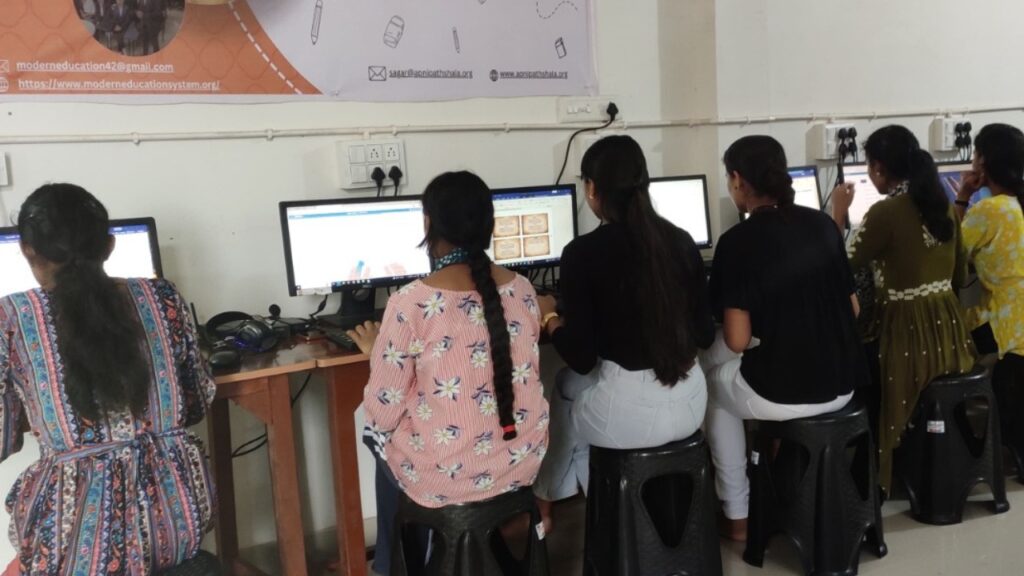
We live in a time when free, high-quality learning resources exist for almost every subject, in almost every Indian language. Exam preparation tools, skill-building courses, subject revision videos, and coding tutorials are all available. But only to students who have a device.
Digital learning access is the bridge between a child’s potential and what the world has already made available. When a student has a personal computer at home, something really changes:
- They can revisit a lesson the same evening instead of waiting for the next class.
- They can go deeper into topics that genuinely interest them, beyond the textbook.
- They can build practical skills, typing, spreadsheets, coding, and design that schools often don’t have time to teach.
- They can prepare for entrance exams independently, without spending thousands on coaching.
- They can explore career paths, earn online certifications, and start building a portfolio before Class 12 ends.
According to the India.gov.in education portal, the government has committed significant investment to building a digital learning infrastructure across the country. Yet that infrastructure can only deliver value to students who have a personal device to connect to it. Infrastructure without access at the individual level is potential that never converts.
What is Apna PC, and how does it help Indian students learn better? The answer starts with reliable, affordable, and at-home putting the right device in a student’s hands.
Turning Access Into a Real Learning Opportunity
Access is the door. Opportunity is what’s waiting on the other side. But if the door stays locked because there’s no device, no reliable time, no quiet moment to sit and study, learning opportunities for students remain theoretical rather than real.
This is why the question for Indian families today can’t simply be “can my child get to school?” It also has to be “Can my child keep learning once school is over?” A student who can review notes at 9 PM after dinner, practice problems on a Sunday morning, or explore a subject no teacher had enough time to cover, that student is quietly building something that others cannot see yet, but will feel in time.
The habit of learning beyond school hours isn’t something only elite students develop. It’s a habit that forms when conditions allow it, when a computer is available, when it belongs to the student, and when using it doesn’t mean waiting for someone else to finish first. According to the Central Board of Secondary Education (CBSE), self-directed study and regular practice outside the classroom are among the most consistent factors in student improvement across subjects.
The Hidden Cost of Not Having a Computer in 2026 is real, and it compounds quietly — one missed revision session, one skipped practice paper, one opportunity that passed because the device simply wasn’t there when the student was ready.
Apna PC was built to close exactly this gap. At just ₹21,000 (shipping and GST excluded), it gives Indian families an affordable, dedicated computer their child can use freely every evening, every weekend, and whenever they are ready to learn without sharing, waiting, or compromise.
Giving your child consistent access to learning is the most direct investment you can make in their future. Visit apnapc.com to learn more.