

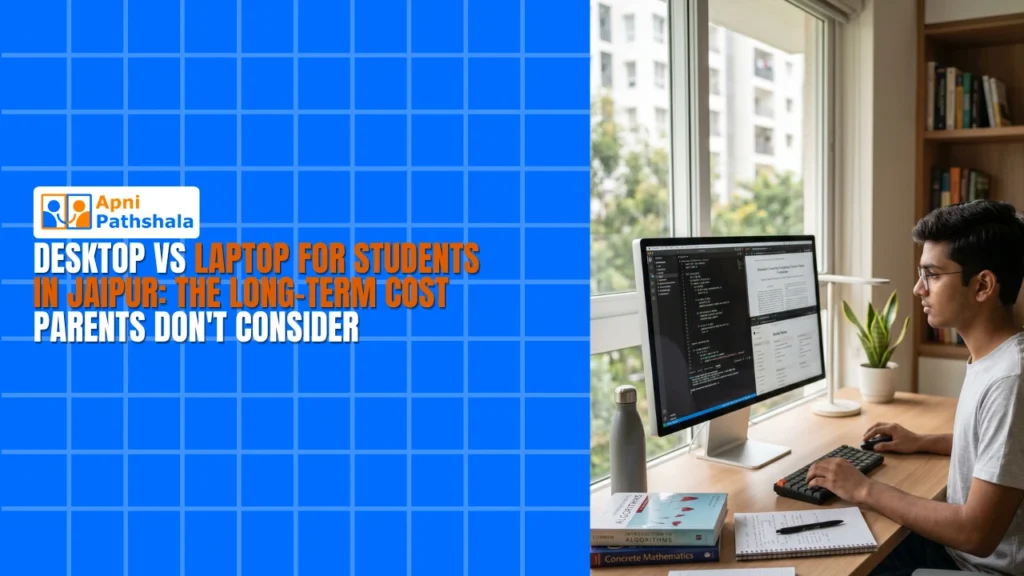
When comparing desktop vs laptop for students, the real cost comparison often surprises families. Desktops consistently deliver more performance and longer hardware life at the same price point, while laptops charge a premium for portability that most school students do not actually need. This guide breaks down the real numbers so families can make an informed choice.
Upfront cost comparison: what do you actually get?
At Rs.30,000, Apna PC offers a complete desktop bundle with CPU, monitor, keyboard, and mouse. A comparable laptop with similar specifications costs Rs.40,000 to Rs.60,000. The price gap comes from the portability premium: laptop components cost more to miniaturise, and the display, battery, and chassis add significant cost that a desktop does not need to include.
- Desktop at Rs.30,000: complete bundle with monitor, keyboard, mouse, 8GB RAM, 128GB SSD
- Basic laptop at Rs.40,000: typically 8GB RAM, 128GB SSD, no accessories included
- Mid-range laptop at Rs.60,000: better build, still requires separate accessories for school desk use
- Repair cost advantage: desktop parts are cheaper and easier to replace individually
- Peripheral savings: desktop keyboard and mouse included in Rs.30,000 bundle
Three-year durability: which survives school better?
Over 3 years of school use, desktops consistently outperform laptops on durability. 95% of desktop failures are component-level, meaning a single cheap part replacement restores full function. Laptop failures often affect multiple systems at once: a battery degrading reduces portability, a hinge wearing out affects the display, and liquid damage from a spilled water bottle is far more damaging on a laptop than on a desktop setup.
Read why parents should think of a computer as an educational investment rather than just a purchase, and how the right choice extends the value of that investment over the full school career.
Hidden costs that change the total comparison
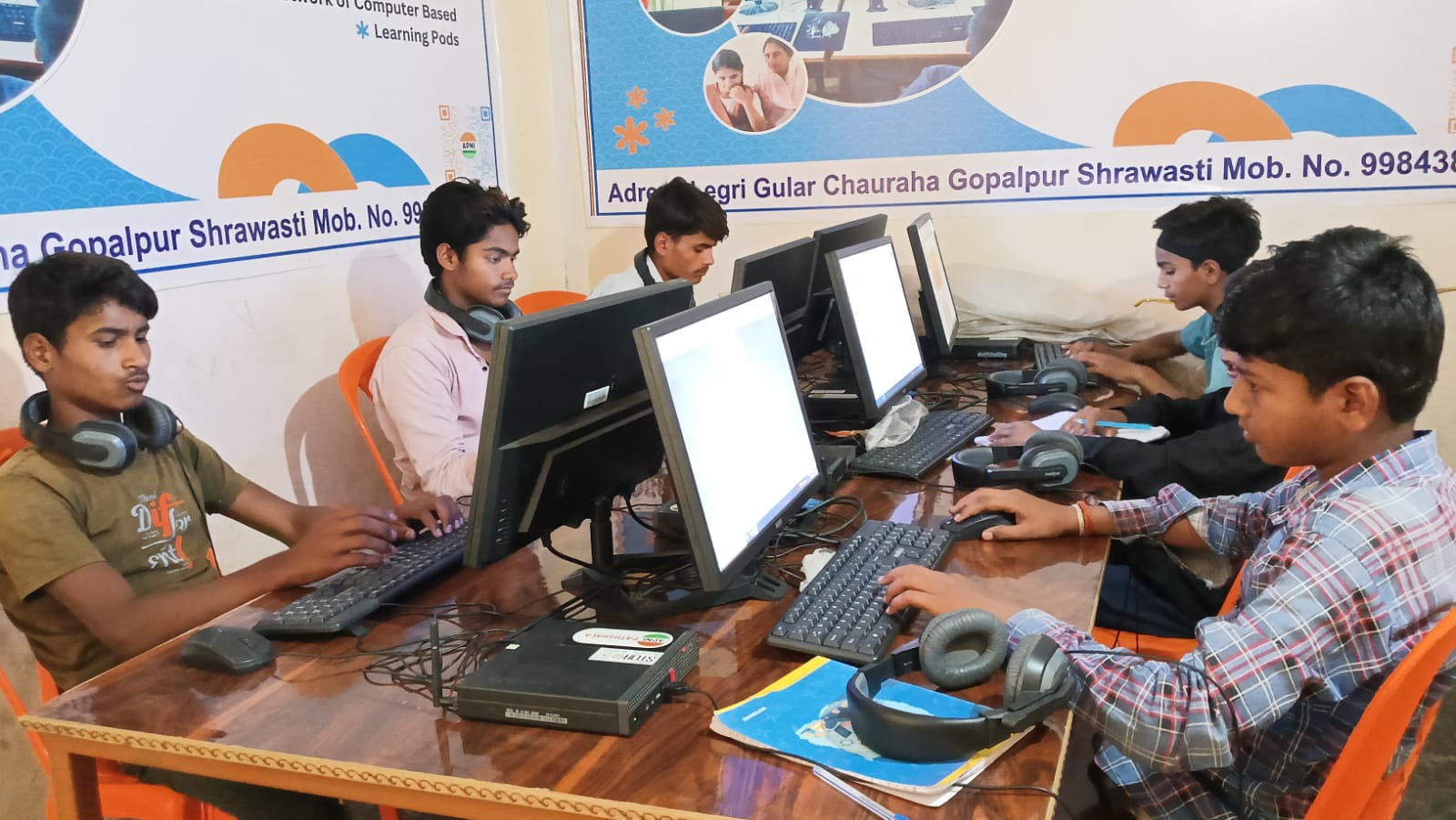
The initial price comparison understates the true cost of a laptop. Consider the full 3-year cost breakdown for both options:
When adding battery replacement (Rs.8,000), charger replacement (Rs.5,000), and accessories over 3 years to a Rs.60,000 laptop, the total rises significantly above the Rs.30,000 desktop bundle. Refurbished vs new computer for students breaks down additional cost considerations for families who want to extend their budget further.
Why a desktop can be better than a laptop for student learning covers additional performance factors beyond cost that families should consider before deciding.
Performance over 3 years: how each ages
At the 3-year mark, 90% of desktop users report their machine still handles all school tasks without noticeable slowdown. This is because desktop components cool better, do not suffer battery-related performance throttling, and can be upgraded individually if one component ages faster than the rest. Laptop performance typically degrades as the battery loses capacity and thermal throttling increases to protect the smaller form factor.
For school students running educational platforms, video conferencing, and document work daily, this performance consistency over 3 years makes desktops the more reliable long-term choice.
When does a laptop actually make sense for a student?
Laptops genuinely make sense for students who have demonstrated consistent, careful device handling and who regularly study in multiple locations without access to power. For students who primarily study at home: the majority of school-going students: portability adds Rs.20,000 to Rs.40,000 in cost without adding value to the daily study routine.
Parents who are deciding between the two options should ask: does my child actually need to carry the computer outside the home regularly? If the answer is no, a desktop delivers better value. If the answer is yes, budget Rs.65,000 to Rs.80,000 for a laptop that will last 3 years at the same performance level as a Rs.30,000 desktop.
Frequently Asked Questions
Is a desktop or laptop better for board exam preparation at home?
A desktop is better for home-based board exam preparation. Desktops provide a larger display for reading question papers and diagrams, better keyboard feel for long typing sessions, and stable performance that does not degrade over the 3-month exam preparation period. A laptop’s portability benefit is irrelevant for home study.
What is the actual price difference between Apna PC and a comparable student laptop?
Apna PC at Rs.30,000 includes a complete bundle. A comparable laptop with the same 8GB RAM and 128GB SSD starts at Rs.40,000 and does not include a monitor or peripherals. Adding a desk monitor (Rs.8,000 to Rs.15,000) and keyboard (Rs.1,500 to Rs.3,000) brings the laptop total to Rs.50,000 to Rs.80,000 for a comparable study setup.
Can a student use Apna PC for competitive exams like JEE and NEET from home?
Yes. Apna PC handles JEE and NEET online mock test platforms, coaching video lectures, and practice problem apps simultaneously without performance issues. The 8GB RAM and 128GB SSD handle the multitasking demands of full competitive exam preparation at home across all coaching platforms and subject resources.
When comparing desktop vs laptop for students, the data consistently favours the desktop for home study use. Visit apnapc.com to learn more about Apna PC and see the full specification and pricing details.