

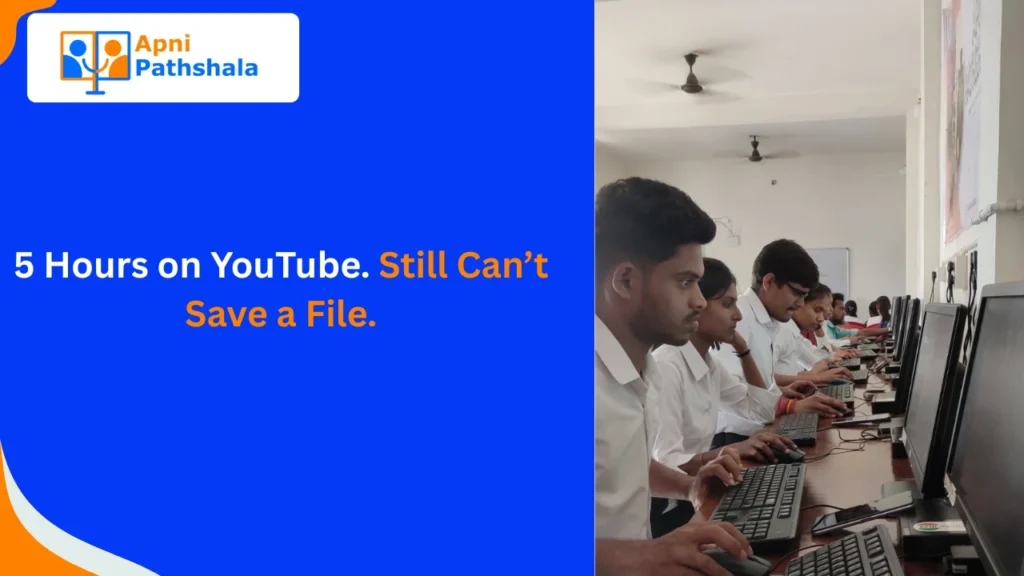
Let’s say your child can download an app in under 30 seconds.
They can switch between five tabs without losing track of any of them. They can find any video on any platform, filter by language, skip the ads, and find the exact timestamp they need.
They are, by every standard, tech-savvy.
Now ask them to save a Word document and find it again later.
Ask them to create a folder structure for their school notes. Ask them to write a professional email to a teacher. Ask them to identify whether a website is credible before copying from it.
Watch what happens.
The Gap Nobody Is Talking About
For a lot of Indian students, especially those in Classes 6 through 10, there’s a gap hiding in plain sight. They are fluent in consumption. They are nearly illiterate in creation and navigation.
This isn’t an attack on their intelligence. It’s actually a structural problem with how digital access happened in most homes.
Smartphones arrived first. Then cheap data. Then YouTube and Instagram and short-form everything. Children learned to consume digital content before they learned to do anything functional with a computer.
The result? A generation that looks digitally fluent but can’t complete a basic task on a keyboard and screen.
What “Digitally Literate” Actually Means
It’s not about how fast you can scroll. It’s about whether you can:
- Create, save, and organize files on a computer
- Type efficiently using both hands (not two thumbs)
- Evaluate whether information online is reliable
- Protect your own privacy when you’re online
- Use software tools to actually produce something
That list isn’t exotic. It’s the baseline for almost every college, government job application, and modern workplace in India.
And a significant number of students, even those who spend hours online every day, can’t do most of it.
The Moment the Gap Becomes Visible
The troubling part is that this gap is invisible to parents until it suddenly isn’t.
A child seems totally comfortable with technology. They help set up the new TV. They fix Wi-Fi problems that stumped their parents. They seem like digital natives.
Then they sit down at a computer lab in college and freeze.
Because phone skills don’t transfer. Operating a smartphone and operating a computer are fundamentally different cognitive tasks. One is thumb-driven, app-organized, and consumer-oriented. The other requires understanding file systems, keyboard shortcuts, document formatting, and structured thinking.
The confidence that came from one doesn’t automatically arrive with the other.
The Class Dimension Nobody Talks About
Middle-class students who grew up with home computers tend to pick up these skills incidentally. Not because anyone taught them, but because computers were just there. They learned by exploring.
Students who grew up with only smartphones, often because a full computer was out of financial reach, missed that accidental learning entirely.
By the time they reach high school, the gap between them and their peers who had computers at home isn’t about effort or intelligence. It’s about years of unequal exposure.
That gap shows up in typing speed. It shows up in how comfortable they are troubleshooting software. It shows up in the quality of their assignments, their resumes, their confidence in job interviews.
Students like Sruthi, who had never touched a computer before joining an Apni Pathshala learning POD, are now sending emails and organizing files. Not because they’re exceptional. Because they got access and guidance.
So What Actually Fixes It?
Not a one-day workshop. Not a single phone app. And not just handing a child a laptop and hoping for the best.
What works is structured, regular, hands-on time with a real computer, in an environment where mistakes are okay and exploration is encouraged.
That’s what community learning centers like Apni Pathshala’s PODs are designed to do. Give students who don’t have computers at home a reliable place to build real digital skills, not just consume content.
And for families who want to close this gap at home, an affordable, purpose-built option like Apna PC was built exactly for this. A computer that doesn’t feel overwhelming for a first-time user, and doesn’t require choosing between buying a device and paying rent.
Here’s the question worth sitting with
Is your child tech-savvy, or digitally literate?
Because in 2026, the difference between those two things might be the difference between a student who gets the internship and one who doesn’t.
It’s not too late to close that gap. But it does require actually looking at it.
What’s one digital skill you wish students in India learned earlier? Drop it in the comments.